Learn how to spot fake sealed Pokémon products with this guide covering shrink wrap logos, pricing red flags, and packaging flaws.
In this guide:
- 1. The #1 Indicator: The Shrink Wrap (Cellophane)
- 2. The Box Analysis (Visual Cues)
- 3. The “Too Good To Be True” Price Rule
- 4. Real vs. Fake Comparison Table
- 5. The Verdict: How to Buy Safely?
The Pokémon TCG (Trading Card Game) sealed market and Pokémon collection platforms have exploded globally, but so have scams. From fake Elite Trainer Boxes (ETBs) to counterfeit booster boxes and resealed packs, collectors and parents are increasingly asking the same questions: What does a fake booster box look like? Why is my Pokémon box so cheap? Are Walmart/Amazon Pokémon cards real? This Fake Pokémon Booster Box guide teaches you how to identify fake sealed Pokémon products before you open them, focusing on the three areas counterfeiters consistently fail at: shrink wrap, packaging quality, and price.
1. The #1 Indicator: The Shrink Wrap (Cellophane)
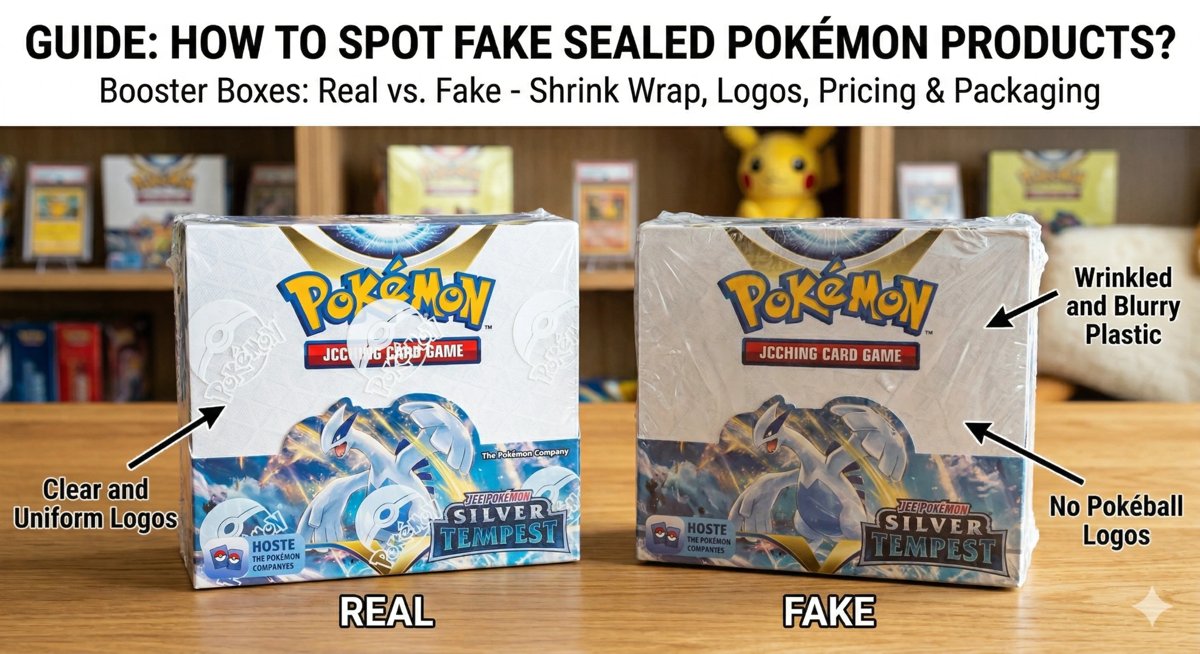
Shrink wrap is the single most important indicator when evaluating sealed Pokémon products. Counterfeiters struggle to replicate official Pokémon wrap consistently, especially on modern English releases.
The “Pokéball” Logo
A common question collectors ask is: Does real Pokémon wrap have logos?
Real Products
- Most modern English Booster Boxes feature shrink wrap stamped with white Pokéball logos and “The Pokémon Company” text
- The plastic feels soft, flexible, and premium
- Logos are evenly spaced and consistently printed
- This is known as the official Pokémon shrink wrap Pokéball logo style.
Fake Products
- Clear plastic with NO logos
- Plastic feels hard, stiff, or crinkly (similar to cheap kitchen wrap)
- Logos, if present, may be blurry, misaligned, or missing text
This leads to another common question: Do all Pokémon booster boxes have Pokéball wrap? Most modern English booster boxes do. Some older sets and certain regional releases differ, but missing logos on modern sets is a major red flag.
Read more about identifying fake Pokémon cards.
The Tightness
Real Products
- Tight and snug, it fits the box like a glove
- Corners are clean with professional seals
Fake Products
- Loose or baggy corners
- Uneven seams or visible glue lines
- The wrap may slide slightly when pressed
This is especially important when evaluating an Authentic vs Fake ETB, since ETBs are frequently resealed after packs are removed.
2. The Box Analysis (Visual Cues)
Once the shrink wrap passes inspection, move on to the box itself. This is where counterfeit products often reveal themselves through low-quality printing.
The “Pixelation” Test
Real Boxes
- Sharp, high-resolution artwork
- Deep, accurate colors
- Fine details are clean and readable
Fake Boxes
- Artwork appears zoomed-in, blurry, or pixelated
- Images are often scanned from a real box instead of original files
- Colors look washed out or faded
For example, in a Fake Silver Tempest Booster Box, Lugia or Alolan Vulpix may appear faded, and silver tones may look grey or yellowed instead of crisp metallic hues.
The Orientation
Another overlooked detail when learning how to spot a fake Pokémon Display is orientation.
Fake Displays
- Side artwork printed sideways or stretched
- Pokémon characters are misaligned on the side panels
- Logos not centered correctly
Real Displays
- Consistent orientation across all panels
- Symmetrical layout and balanced spacing
The Text & Typos
Text errors remain one of the easiest ways to detect fakes. Look for:
- “Pokemon” instead of Pokémon
- “Gi” instead of GO
- Incorrect product descriptions (e.g., Sword & Shield packs on a Scarlet & Violet box)
- Missing legal text or copyright year mismatches
These issues appear frequently in listings that involve identifying fake Pokémon packs and resealed boxes.
3. The “Too Good To Be True” Price Rule
If there is one rule that prevents most sealed-product scams, it’s this: No legitimate seller sells Pokémon sealed products below cost.
The Math
- Real booster box wholesale pricing is roughly $90–$100
- Retail prices usually fall between $100–$160+, depending on demand
The Scam
If you see:
- A Silver Tempest Booster Box for $45–$50
- ETBs priced under $30
- Charizard UPCs for $70
- …it is fake. Every time!!
This is why so many buyers end up Scammed on TikTok Shop Pokémon listings, where counterfeit boxes are advertised using stolen photos and influencer-style videos.
Dangerous Listing Keywords
Avoid listings that include:
- “Proxy”
- “Replica”
- “Flash Cards”
- “Unbranded”
These terms often relate to Pokémon card proxy box meaning a legal workaround sellers use to distribute counterfeit sealed products while avoiding direct infringement language.
4. Real vs. Fake Comparison Table
| Feature | Real Sealed Products | Fake Sealed Products |
|---|---|---|
| Price | $100–$160+ | $30–$60 |
| Shrink Wrap | Pokéball Logos, Soft | Clear, Hard, Crinkly |
| Pack Arrangement | Neatly Organized | Messy or Vertical |
| Box Material | Thick, Sturdy Cardboard | Thin, Flimsy |
| Pull Rates | Truly Random | “God Packs” or No Hits |
Fake boxes often advertise impossible pull rates—either every pack has hits, or none do, both of which are unrealistic.
5. The Verdict: How to Buy Safely?
Reputation Matters
The safest approach is buying from trusted sellers. Safe places to buy Pokémon booster boxes include:
- Established Local Game Stores (LGS)
- Pokémon Center (official)
- Highly rated hobby retailers with long sales history
Are Walmart/Amazon Pokémon cards real? Yes, when sold and shipped directly by Walmart or Amazon. Problems arise with third-party marketplace sellers.
Avoid Social Media Traps
Many victims report identical scam patterns across platforms. Be extremely cautious on:
- TikTok Shop
- Instagram ads
- Facebook Marketplace
- Avoiding Pokémon scams on eBay
The Shake Test (Myth)
Shaking the box does nothing. Loose packs can occur naturally. Focus on:
- Shrink wrap
- Print quality
- Price logic
When in Doubt - How to Tell if an Elite Trainer Box is Resealed?
Is my Charizard UPC fake? Compare your product directly with official images from the Pokémon Center website. Differences become obvious when viewed side-by-side.
Final Takeaway
What does a fake booster box look like? Counterfeit sealed Pokémon products follow predictable patterns. If you evaluate shrink wrap quality, packaging precision, and pricing realism, you can avoid nearly every scam before opening the box. Education (not luck) is your strongest protection in today’s Pokémon TCG market.