Impact of scalpers on Pokémon TCG & Why Investing Saves It
 Pokefolio
In this guide:
- 1. Definitions: The Good vs. The Bad
- 2. The Economic Impact - Does Scalping Increase Card Value?
- 3. How to Collect or Invest Ethically? (The Code of Conduct)
- 4. Investor vs. Scalper Comparison Table
- 5. The Verdict: Be a Guardian, Not a Pirate
Learn the difference between Pokémon investing vs scalping, how scalpers impact the hobby, and how to collect ethically without harming the Pokémon TCG market.
The Pokémon Trading Card Game has grown from a children’s pastime into a global collectibles market worth billions. Many collectors still ask: What is a Pokémon scalper? What is the real Pokémon scalping definition, and is Pokémon card collecting ethical when profit is involved? With that growth has come a heated debate: Pokémon investing vs scalping. Are they the same thing? Is Pokémon card collecting ethical when money is involved? And why does this distinction matter so much to the future of the hobby and every TCG platform?
This article breaks down the difference clearly, explains the economic and community impact, and offers a practical ethical framework for collectors who want to invest without harming the ecosystem that makes Pokémon valuable in the first place.
1. Definitions: The Good vs. The Bad
Understanding the difference starts with clear definitions. Confusion between these roles is the root of most online arguments.
The Scalper (Short-Term Flipper)
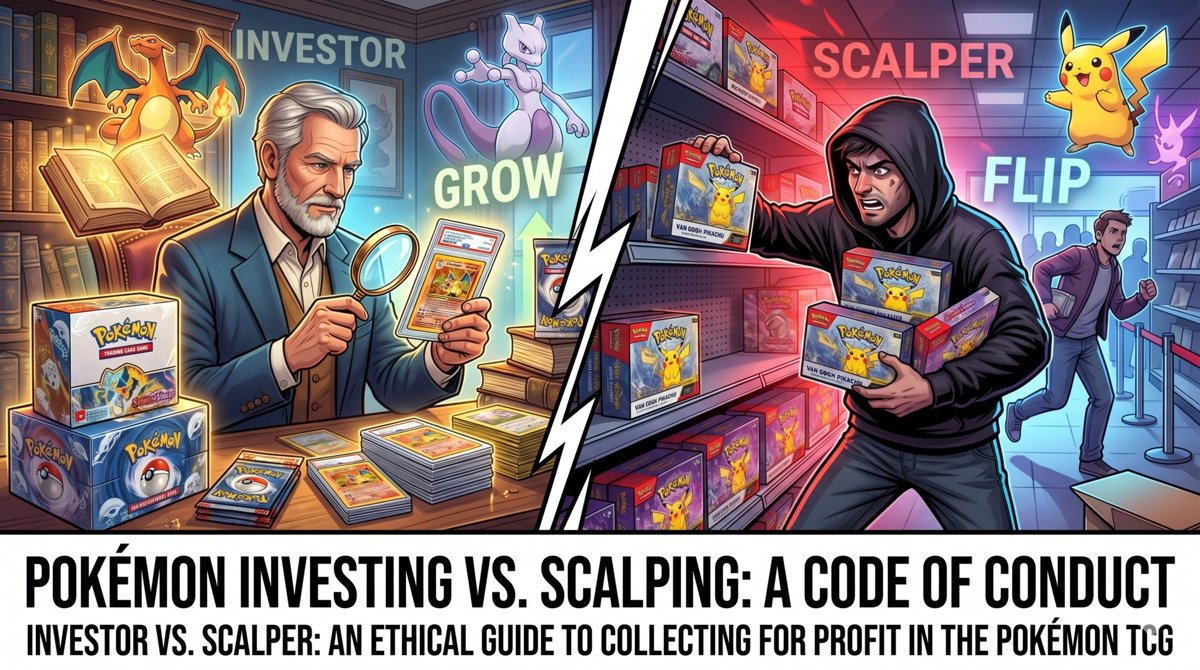
To answer the question “What is a Pokémon scalper?”, we need to look at behavior, not intent. A scalper buys current retail stock, often from Walmart, Target, or Local Game Stores, in excessive quantities. This includes clearing shelves, buying entire cases, or using bots online when the second product drops. This behavior fits the Pokémon scalping definition used across collecting communities.
The goal is simple: flip the product immediately, usually within days or weeks, for a quick 20–50% profit while hype and fear of missing out (FOMO) are high. This is why people constantly ask, “Why are Pokémon cards sold out everywhere?” In reality, shelves are rarely empty because Pokémon cannot print enough cards. They are often empty because of coordinated short-term buying behavior during hype cycles.
The results show an extreme negative outcome. Scalping prevents kids, parents, and genuine collectors from buying products at MSRP (Manufacturer's Suggested Retail Price). The situation creates anger and toxic behavior, which causes people to lose trust in the community. Why do people hate scalpers? The hatred towards scalpers exists because people dislike them for their money-making activities, which produce no value to others. The conduct of scalpers shows how their actions create a negative effect on both Pokémon TCG availability and public perception.
The Investor (Long-Term Guardian)
An investor operates on a completely different timeline and philosophy. Rather than flipping current hype, investors buy items with the intention to hold them for years, often 5, 10, or even 20 years. They frequently buy after the hype fades, purchase on the secondary market, or focus on older and vintage items that are already out of print.
The goal is long-term appreciation and preservation. This aligns with a long-term Pokémon holding strategy, not quick profit. The impact is surprisingly positive. In ten years, the only reason anyone will be able to open a Scarlet & Violet booster box is that an investor kept one sealed and protected today. This is the key difference between flipper and investor: time horizon and contribution to future availability.
2. The Economic Impact - Does Scalping Increase Card Value?
Artificial Scarcity and Market Manipulation
Pokémon prints millions of cards. The idea that a handful of scalpers can permanently control supply is a myth, but they can create short-term artificial scarcity.
This is a classic example of Pokémon market manipulation. Scalpers attempt to corner the market briefly, hoping prices spike before reprints arrive. When reprints do happen, scalpers often become “bag holders,” stuck with overpriced inventory they can’t move.
Will Pokémon print more cards to stop scalpers? Historically, yes. Pokémon has repeatedly reprinted popular sets to stabilize the market and protect accessibility.
The Van Gogh Pikachu promotional card that the Van Gogh Museum in Amsterdam issued serves as a current demonstration of how scalpers harm the Pokémon TCG game. The card, which was created to honor both art and Pokémon culture, experienced a chaotic launch that resulted in unexpected problems. Resellers formed large groups, which they used to empty both physical and online stores because they cleared all available stock within the first few minutes. The card became inaccessible to authentic collectors and family groups because it exceeded its retail price.
Cardmarket listings appeared within hours at prices multiple times higher than the original value that created an impression of extreme product scarcity. The situation represents a typical example of short-term Pokémon market manipulation that occurs through hype and flipping activities which people do for profit. Pokémon re-released the card after facing major backlash to control product availability problems. The practice of short-term scalping creates immediate financial gains; for this reason, it fails to build lasting business success.
Healthy Market Growth
A healthy Pokémon market needs three groups to coexist: players, collectors, and investors. If new collectors (especially kids) can’t enter the hobby because shelves are empty, interest declines. If interest declines, demand collapses. And if demand collapses, long-term investments become worthless.
This is why the question “Is Pokémon investing dead?” misses the point. Pokémon investing isn’t dead, but bad behavior CAN kill it. Ethical investing supports long-term growth. Scalping undermines it.
3. How to Collect or Invest Ethically? (The Code of Conduct)
For those asking how to invest in Pokémon cards ethically, the answer lies in conduct, not labels.
First, don’t clear shelves. Buying one or two items is normal. Buying everything in sight is not. Shelf-clearing directly fuels resentment and harms accessibility.
Second, don’t use bots. Automated purchasing removes fairness entirely and crosses a clear ethical line.
Third, add value. Investors add value by preserving condition, grading important cards, and storing sealed products safely. Scalpers extract value without improving the product in any way.
Fourth, target the right products. Limited Pokémon Center exclusives, collector boxes, or high-end items are fair game. Clearing out children’s tins, holiday bundles, or Happy Meal promos is widely considered unethical.
Is buying sealed boxes considered scalping? Not inherently. Buying a reasonable quantity for a long-term Pokémon holding strategy is fundamentally different from clearing shelves on release day to flip within 48 hours. Intent, scale, and time horizon define the difference between a flipper and an investor.
4. Investor vs. Scalper Comparison Table
| Aspect | Investor | Scalper |
|---|---|---|
| Time Horizon | Years / Decades | Days / Weeks |
| Source | Secondary Market / Distributors | Retail Shelves |
| Risk | Market Risk | Reprint Risk |
| Community View | Respected / Neutral | Hated |
5. The Verdict: Be a Guardian, Not a Pirate
There is nothing wrong with wanting your collection to grow in value. Tracking sealed products, graded cards, and long-term performance using tools like PokéFolio is smart, not greedy. The real question is how you participate in the market.
Scalpers treat the hobby like a resource to strip-mine. Investors treat it like a museum, preserving history so future collectors can experience it. If you care about Pokémon, choose the second path. Build a collection you’re proud of, not just a pile of boxes you plan to flip next week.