Is Opening Pokémon Packs Worth It? The Cost of "The Chase"
 Pokefolio
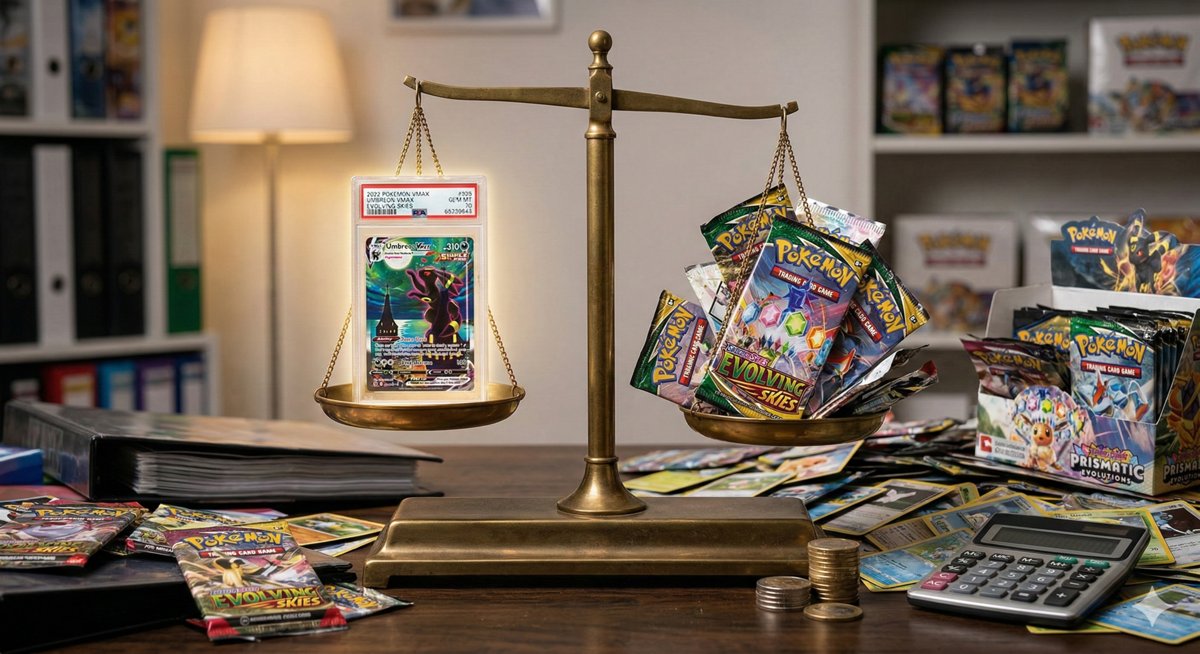
Pokémon pull rates 2026 explained: Learn the real cost to pull Pokémon cards, compare booster boxes vs singles, and see why opening packs is a losing game. As modern sets continue expanding their Secret Rare and Illustration Rare pools, many collectors are now asking: What are the odds of pulling a Secret Rare in 2026, and are those odds getting worse?
Opening Pokémon booster packs has always felt magical. The sound of tearing foil, the flash of a holo, the dream of pulling a chase card, it’s part of the DNA of the Pokémon TCG. But when emotion meets mathematics, the illusion starts to crack. To answer questions like Is opening Pokémon packs worth it?, Should I buy booster boxes or singles? And which Pokémon set has the best hit rates? We need to understand one thing first: PULL RATES !
1. What is a “Pull Rate”? (The Foundation)
What are Pokémon TCG pull rates? A pull rate is the average probability of obtaining a specific card rarity from a booster pack, commonly expressed as ratios like “1 in 32 packs” or “1 in 280 packs.” These probabilities apply to rarities such as Ultra Rares, Secret Illustration Rares (SIR) , and Hyper Rares.
The Myth of the Booster Box
One of the most persistent myths in the hobby is that buying a full booster box (usually 36 packs) guarantees a high-end hit. It does not! Pull rates are statistical averages, calculated across thousands (or even millions) of packs. You can open multiple boxes without seeing a Secret Rare, while another opener might pull one in a single pack. This is why Booster box vs Singles math overwhelmingly favors singles for anyone with a specific target card.
Where the Numbers Come From
The Pokémon Company does not publish official pull rate data. Estimates come from large-scale community tracking projects, Cardmarket sales observations, and independent data gathered from mass openings shared by collectors and high-volume YouTube openings. When thousands of booster packs are opened publicly and results are documented, reliable probability patterns begin to emerge. While these numbers are never official guarantees, they provide realistic statistical expectations.
2. The Great Comparison: “Generous” Sets vs “Fan Traps”
Not all Pokémon sets are created equal. Some reward frequent opening; others are expertly designed to look generous while quietly draining wallets.
The Trap: Prismatic Evolutions
Few modern releases have sparked as much debate as Prismatic Evolutions.
The Issue:
At first glance, the set feels rewarding. Shiny cards appear often, leading many to believe the Prismatic Evolutions hit rates are excellent. But the real problem lies deeper: the chase pool is enormous.
The Math:
When you factor in the massive number of chase cards, pulling a specific Eeveelution SIR (such as Umbreon) becomes statistically brutal. When the full chase pool is analyzed, pulling one specific Eeveelution Special Illustration Rare becomes statistically very difficult. Community tracking suggests odds well into the hundreds of packs for a specific target card, depending on print wave and distribution, raising serious questions like Is Prismatic Evolutions worth buying? Whether Prismatic Evolutions is worth buying depends entirely on your goal. For entertainment and variety, it may feel rewarding. For targeting a specific high-value card, singles remain statistically safer. This frustration has reignited discussions around What are the odds of pulling a Secret Rare in 2026? and how modern set design increasingly favors hype over accessibility.
The Nightmare: Evolving Skies Pull Rate History
Evolving Skies pull rate history remains infamous. Independent community data suggested extremely low odds for the Umbreon VMAX Alternate Art, making it one of the most difficult modern chase cards to pull. The nickname “Evolving Cries” reflects how punishing the set felt financially for many collectors. The community didn’t call it “Evolving Cries” by accident. This set is a textbook example of extreme rarity driving long-term value, but punishing pack openers financially.
The Good Guy: Crown Zenith
If any modern set deserves praise, it’s Crown Zenith. Why It WorksWhich Pokémon set has the best hit rates? The Crown Zenith pull rates were widely celebrated thanks to the Galarian Gallery. Community opening data showed that meaningful Galarian Gallery hits appeared frequently compared to most modern sets, making Crown Zenith pull rates feel generous relative to other expansions. When the goal is pure enjoyment.
3. The Financial Equation: “Cost to Pull”
To truly understand the economics of the Pokémon TCG, collectors must learn one metric: What is the “Cost to Pull” ratio? It is the comparison between the expected money required to statistically pull a card from sealed packs versus the direct market price of buying that card individually. When the Cost to pull exceeds the market value by a large margin, opening packs becomes financially inefficient. For example, if a Secret Rare appears on average once every 300 packs, and each pack costs €5, the statistical expectation to pull one would be around €1,500, with no guarantee of hitting the specific card you want.
Cost to Pull vs. Market Price
- Market Price : What a card costs to buy as a single.
- Cost to Pull Pokémon cards : The expected amount of money required to pull that card from packs, based on probability.
Case Study: The Chase Card Reality
Should I buy booster boxes or singles? Now , if we collect all pieces together, take a modern chase card, such as Umbreon SIR or Greninja ex.
- Buy as a Single (Cardmarket average range): approximately €130–€170 depending on condition.
- Estimated Cost to Pull: statistically, several thousand euros worth of sealed product when factoring in probability variance.
From a financial standpoint, the answer is clear!
The Final Verdict
Is opening Pokémon packs worth it? Opening packs is entertainment driven by randomness and excitement. Where variance, emotion, and dopamine rule. Buying singles is investing . It is controlled, predictable, and value-driven. Collectors serious about capital preservation, Pokemon card grading, and long-term value should prioritize singles and card protection strategies.
Final Thoughts
With Pokémon pull rates 2026 continuing to trend toward larger chase pools and lower individual odds, understanding the math is no longer optional. Whether you’re evaluating Booster box vs Singles math , questioning Is opening Pokémon packs worth it , or analyzing Prismatic Evolutions' hit rates , one truth remains constant: With chase pools expanding and special rarities increasing across modern releases, Pokémon pull rates 2026 reflect a design philosophy that prioritizes collectibility and long-term rarity over easy accessibility .
"Ripping packs is fun. Buying singles is smart. Knowing the difference is what separates collectors from investors."
i love opening packs
I also really love opening boosters, but since I only collect the Master Sets, I have to stop at some point—otherwise I’ll just end up with duplicates, and that gets really expensive.
The last sentence hits the nail on the head 👍🏻 Maths is cruel 🥲