Pokémon Sealed vs Singles Investment: Which Yields Better?
 Pokefolio
Explore Pokémon sealed vs singles investment strategies, comparing risk, EV, and long-term value to decide whether sealed boxes or cards perform better.
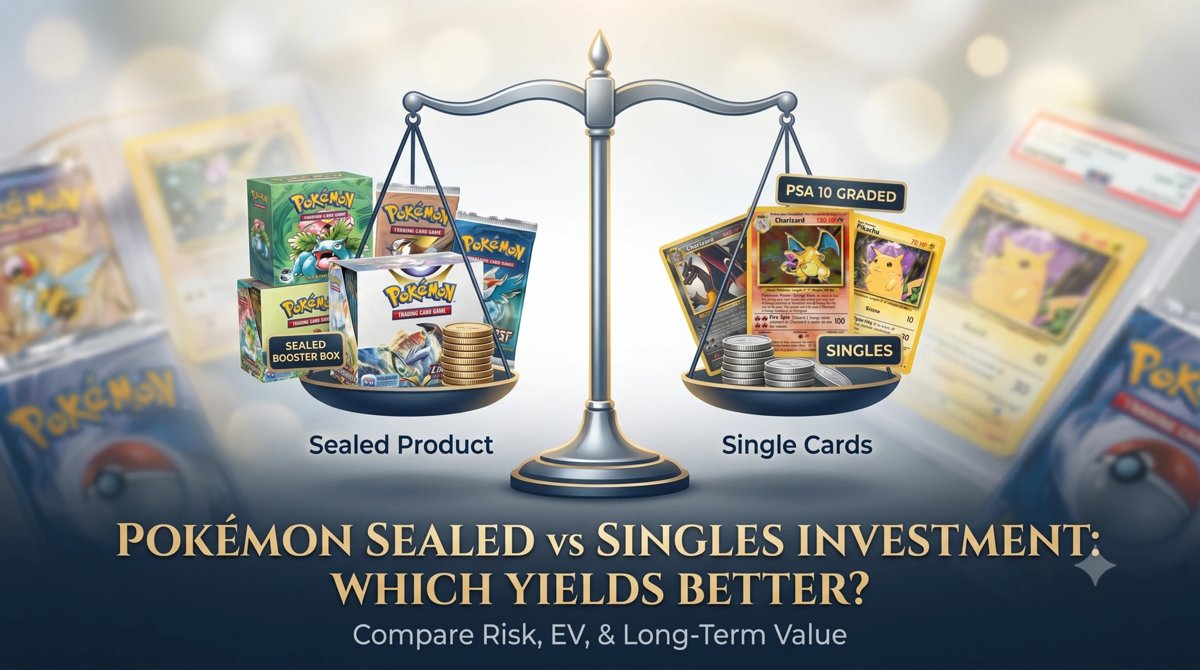
One of the most common (and most misunderstood) debates in the hobby is Pokémon sealed vs singles investment. New investors often ask the same questions: Is it better to buy boosters or singles? Does keeping Pokémon cards sealed increase value? Why is the sealed box worth more than the cards inside? This guide breaks down both sides with a clear financial lens, explains the economic principle of diminishing sealed supply, and outlines the best Pokémon investment strategy 2026 based on risk management, not hype.
The Case for Singles (High Risk / High Reward)
Single cards are often the emotional entry point into Pokémon investing. You see the artwork, you recognize the character, and the value feels tangible.
The Appeal of Singles
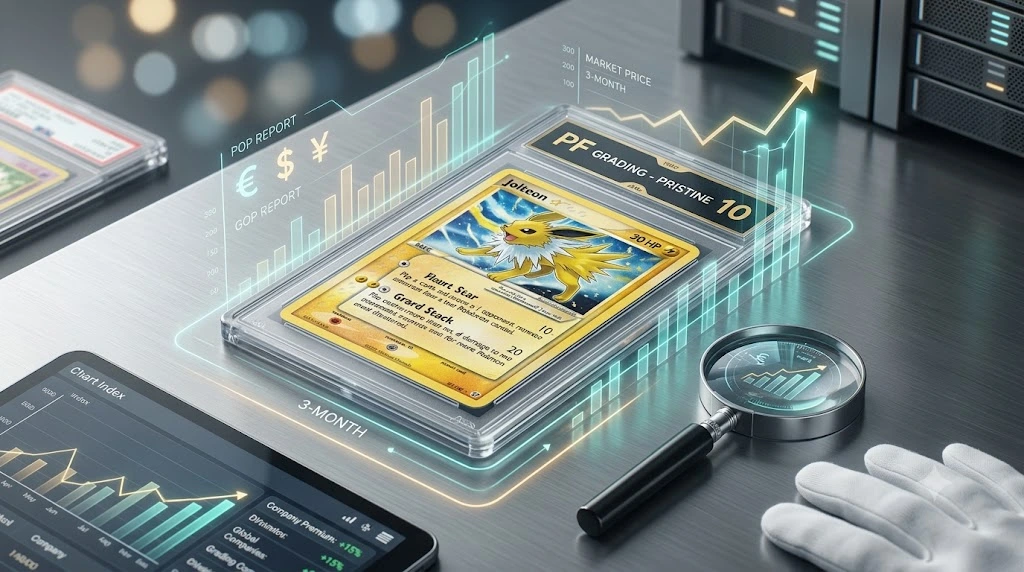
When you buy a single card (especially a graded one) you own a specific piece of art and history. A PSA10 Charizard, Umbreon, or Pikachu is highly liquid and easy to sell globally. Singles take up very little space, ship easily, and display beautifully. For many investors, this makes singles feel like the “cleaner” asset.
This is why questions like “Is it better to buy boosters or singles?” don’t have a simple yes-or-no answer. Singles clearly have advantages.
The Volatility Problem
However, single cards are extremely volatile. Prices swing based on: Competitive gameplay relevance, sudden social media hype, influencer trends, new reprints or alternate artworks.
A card that is a $300 staple today in Pokémon TCG platform can drop to $80 in months if it falls out of the meta. This volatility is why singles are often unsuitable as a core long-term position.
The Condition Trap
Raw singles are what investors call decaying assets. Even microscopic flaws—corner whitening, surface scratches, centering issues, can slash value by 30–50% instantly. Unless a card is graded and properly stored, its value is constantly at risk. This is why singles work best for surgical investing: targeting specific cards you understand deeply, not broad exposure.
"Verdict: Singles are ideal for passion plays, display pieces, and high-risk/high-reward bets, but not for conservative capital preservation."
The Case for Sealed Product (The “Safe” Bet)
Sealed product operates under a fundamentally different economic model, and that’s why serious investors gravitate toward it.
The Economic Rule: Diminishing Supply
Once a Pokémon set goes out of print, the supply of sealed product can only go down. It never increases. Every booster box opened on YouTube permanently reduces global supply.
This is the foundation of Investing in Pokémon booster boxes and the reason people ask why are sealed booster boxes so expensive years later. Scarcity compounds over time.
Do sealed Pokémon products always go up? No asset is guaranteed, but sealed products benefit from the strongest long-term supply mechanics in the hobby.
Zero Condition Risk
When you invest in sealed, you don’t care about centering, print lines, or whitening. You’re selling the box itself, not the cards inside. This removes the biggest risk singles face.
This is what collectors mean by sealed premium Pokémon meaning: you’re paying for untouched condition, authenticity, and time.
The Index Fund Analogy
Buying a booster box is like buying an ETF instead of a single stock. You’re not betting on one Pikachu or Charizard, you’re betting on the long-term relevance of the entire set. What is the safest Pokémon investment? Not risk-free, but historically the most stable.
The “Vintage Paradox”: Why Is Sealed Worth More?
How to store sealed Pokémon boxes for investment? This is where many beginners get stuck. They calculate the Pokémon EV (Expected Value) explained and realize the cards inside a vintage box are worth far less than the sealed box itself. So why pay more?
The Math Behind EV
Expected Value is the average value of the cards inside if you opened many boxes. Vintage EV is usually far lower than sealed prices. That’s because EV ignores probability distortion. This is also why there is a massive risk of opening vintage Pokémon packs. Once opened, the box loses its premium instantly, even if you pull something decent.
The “Schrödinger’s Cat” Effect
As long as a box is sealed, it could contain a pristine Black Label 10 card worth tens of thousands of dollars. The moment you open it, that possibility collapses. This psychological premium explains why is the sealed box worth more than the cards. The value lies in potential, not cardboard.
The Experience Premium
Collectors pay for nostalgia, spectacle, and history. Should I open my Elite Trainer Box? From an investment perspective: almost never! Once opened, the experience is gone forever.
Sealed vs Singles Comparison Table
Storage Space
Singles
Low
Sealed Product
High / Bulky
Liquidity
Singles
High
Sealed Product
Medium (shipping/logistics)
Volatility
Singles
High price swings
Sealed Product
Slow, steady growth
Risk
Singles
Condition, reprints
Sealed Product
Storage damage
Why is the sealed box worth more than the cards? When evaluating ROI of sealed vs graded cards, sealed tends to win on consistency, while singles win on occasional explosive gains.
The Verdict: The 70/30 Rule
Tracking this balance with tools like PokéFolio helps investors stay disciplined instead of emotional. The most resilient portfolios are diversified. A commonly recommended structure for serious collectors is:
- 70% Sealed: long-term capital preservation and steady appreciation
- 30% Singles (graded): passion, display, and selective high-upside bets
Conclusion
So, Does keeping Pokémon cards sealed increase value? Historically, yes. Because you can’t print more history. A sealed vintage product is finite. Singles come and go. That is why sealed remains the cornerstone of serious Pokémon investing, and why it continues to outperform over long time horizons.