PSA vs PCA label vs Pure Grading: Which Slab is Best?
 Pokefolio
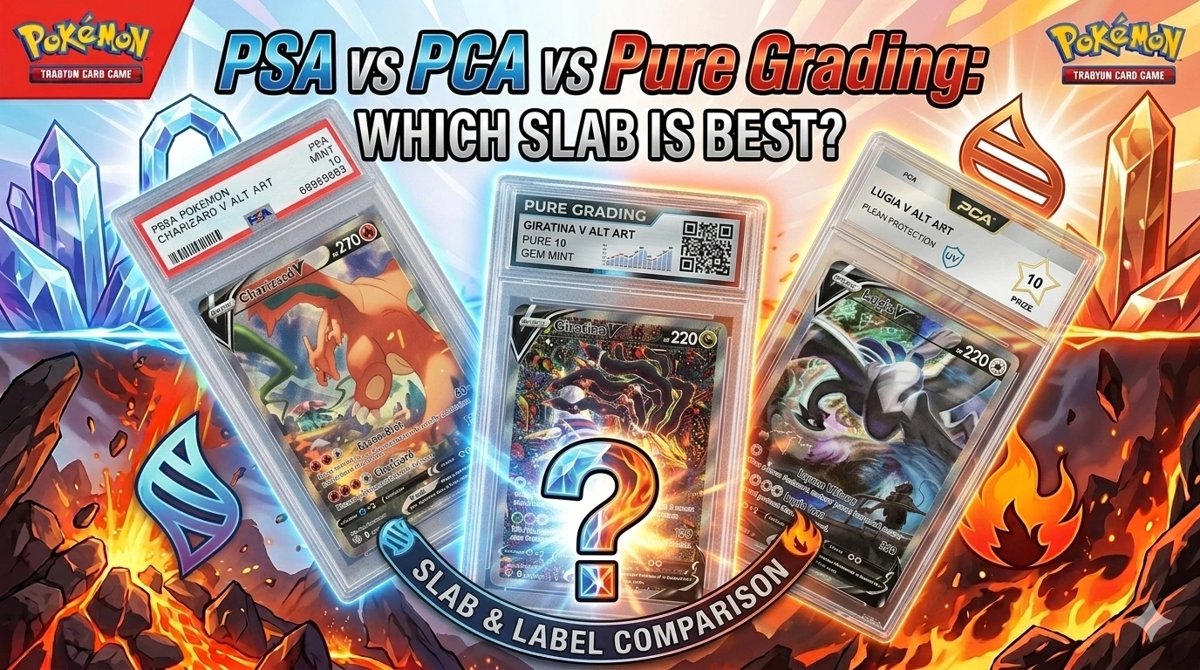
Compare Pokémon slab comparison features for PSA, PCA, and Pure Grading. Find the best PSA vs PCA label for your collection and Pokémon investment needs.
The Ultimate Pokémon Slab & Label Guide: PSA vs PCA label vs. Pure Grading
The Pokémon collecting community evaluates multiple aspects of a collection item, but considers grade as one of its important elements. The modern collector requires both the "slab" which serves as their physical plastic container, and the label design to function as vital components of their collection. The right grading company selection becomes essential when you want to achieve maximum resale value, create an attractive Pokémon collection in your Pokémon portfolio tracker, or obtain technical data that demonstrates your card's perfect condition. The guide explains how PSA, PCA, and Pure Grading operate in the European market by outlining their three main business functions: security systems, design standards, and operational capabilities. Compare Pokémon slab comparison features for PSA, PCA, and Pure Grading. Find the best PSA vs PCA label for your collection and Pokémon investment needs.
1. The Anatomy of a Good Slab & Label
"The general concept of 'top-tier' encapsulation needs to be understood before studying particular brands. A quality Pokémon slab comparison begins with two main components: the case and the label."
The Case (Slab): A premium slab must offer absolute clarity to ensure the card’s holographic patterns pop. The collectors display their cards because they require UV protection, which prevents sunlight from damaging the ink over time. The security system uses ultrasonic welding, which creates a permanent connection between plastic halves, forming a secure unit.
The Label: This is the card's "ID." A professional label must balance readability and aesthetics. Security features such as holograms and UV-reactive ink prevent counterfeiting, while data points such as barcodes, QR codes, and subgrades provide the transparency required for high-value transactions.
2. The Competitors: Slab & Label Analysis
For collectors in Europe, the choice generally comes down to these distinct philosophies.
PSA (The Global Standard)
Professional Sports Authenticator (PSA) remains the undisputed heavyweight champion of the hobby. If you are wondering what a PSA label looks like, the answer is "iconic."
The Case: PSA uses a light and thin slab. It features "frosted" edges, which some collectors find classic, though others argue it feels slightly dated compared to modern "crystal-clear" alternatives.
The Label: The famous red and white border is a beacon for investors. It features a holographic logo and standard barcode.
The Vibe: Traditional, authoritative, and universally recognized.
PCA (The European Minimalist)
Professional Cards Authenticator (PCA) is a France-based company that conquered the European market by prioritizing the "art" of the card.
The Case: PCA slabs are known for their high transparency and sturdy feel. They place a strong emphasis on UV protection, answering the common collector question: "Are PCA cases UV protected?" (Yes, specifically designed for long-term display).
The Label: The design is sleek and minimalist. For the highest grades, they often use metallic or gold labels. The goal is to fade away; the label is designed to avoid distracting from the Pokémon artwork.
The Vibe: Premium, modern, and art-focused.
Pure Grading (The Tech Innovator)
Which Pokémon slab is hardest to crack? Pure Grading is the newcomer disrupting the industry with an "objective-first" approach.
The Case: They are crystal clear and offer an exceptionally premium feel in hand. They are highly resistant and designed to offer maximum physical security.
The Label: This is where innovation shines. Every label includes a prominent QR code linking to a digital report.
The Vibe: Transparent, data-driven, and futuristic.
3. The Verdict for YOUR Needs
For the Investor / Reseller: Choose PSA. If your primary goal is "liquidity" — the ability to sell your card quickly for the highest possible price — stick with PSA. While it might not be the most beautiful slab, the global market trusts the red label. A PSA 10 is the universal "gold standard" in pricing.
For the Art Lover / Display Collector: Choose PCA. Why choose PCA over PSA for a display collection? Because PCA understands that a loud red border can clash with a beautiful Alt-Art Lugia or Charizard. If you want your collection to look like a curated art gallery, PCA’s minimalist labels and superior UV protection make them the clear aesthetic winner.
For the "Data Nerd" / Modern Collector: Choose Pure Grading. If you’ve ever wondered "How to read a Pokémon grading label?" and wanted more than just a number, Pure Grading is for you. Is the Pure Grading QR code useful? Absolutely. By scanning it, you access a digital "fingerprint" of your card. You can see the exact AI-mapped scratches and centering data that determined the grade, offering a level of transparency that human graders simply cannot match.
FAQ: Pokémon Slab Comparison - Quick Hits for Collectors
Which grading company has the best-looking slab? Aesthetics are subjective, but PCA is generally cited for its "art-first" minimalist look, while Pure Grading wins for "crystal-clear" premium feel.
Are PSA cases UV protected? While they provide a baseline of protection, they are not rated as high for UV resistance as PCA's specialized cases.
What does a Pure Grading AI report look like? It is a high-resolution digital map of your card showing precise microscopic flaws, centering percentages, and edge wear.
Is there a simpler guide for Pokémon Grading for Beginners? Read this article about what Pokémon grading is.
Conclusion
Whether you value the heritage of PSA, the elegance of PCA, or the precision of Pure Grading, the difference between PSA and PCA slabs (and Pure Grading) is ultimately about how you want to experience your collection.