Cross grading Pokémon cards and "Cracking" Slabs: Is It Worth the Risk?
 Pokefolio
Master cross grading Pokémon cards with our guide on PCA to PSA crossover and how to crack a PSA slab safely to maximize your collection's value.
The plastic case, which collectors use to protect their Pokémon cards, is their most valuable asset because it establishes the cards' value. The market develops new grading companies alongside existing player PSA, which now operates the PSA Germany grading facility, enabling European Pokémon collectors to determine the value of their cards through their collections. The process known as Cross grading Pokémon cards allows users to transfer cards from one grading company to another through their existing encapsulation system. Collectors who want to use "PSA Premium" for resale or to display their collection in a single common design have two options: the official "Crossover" service and the risky "Cracking" method. The guide presents an investigation into the operational systems in both methods, examining their associated hazards and potential benefits.
In this guide:
- 1. What is Crossover Grading for Pokémon Cards?
- 2. The "Cracking" Method (The Risky DIY Route)
- 3. How People Actually Crack Slabs (Educational Only)
- 4. The Verdict: Cross Grading Pokémon Cards - When to do it?
1. What is Crossover Grading for Pokémon Cards?
The official crossover service provides the safest and most professional way to transfer your collection in accordance with industry standards. Major companies such as PSA and BGS use this path as their official method for handling crossovers between their grading systems. What exactly does crossover grading for Pokémon cards involve, according to its actual implementation?
You need to send the card for crossover, which requires keeping it in its original slab (e.g., a PCA or BGS case). Your submission requires you to establish a Minimum grade crossover PSA that must meet PSA standards for crossover purposes. You would set "PSA 10" as your minimum requirement for a PCA 9.5 if you believe the card has the potential to achieve top-grade.
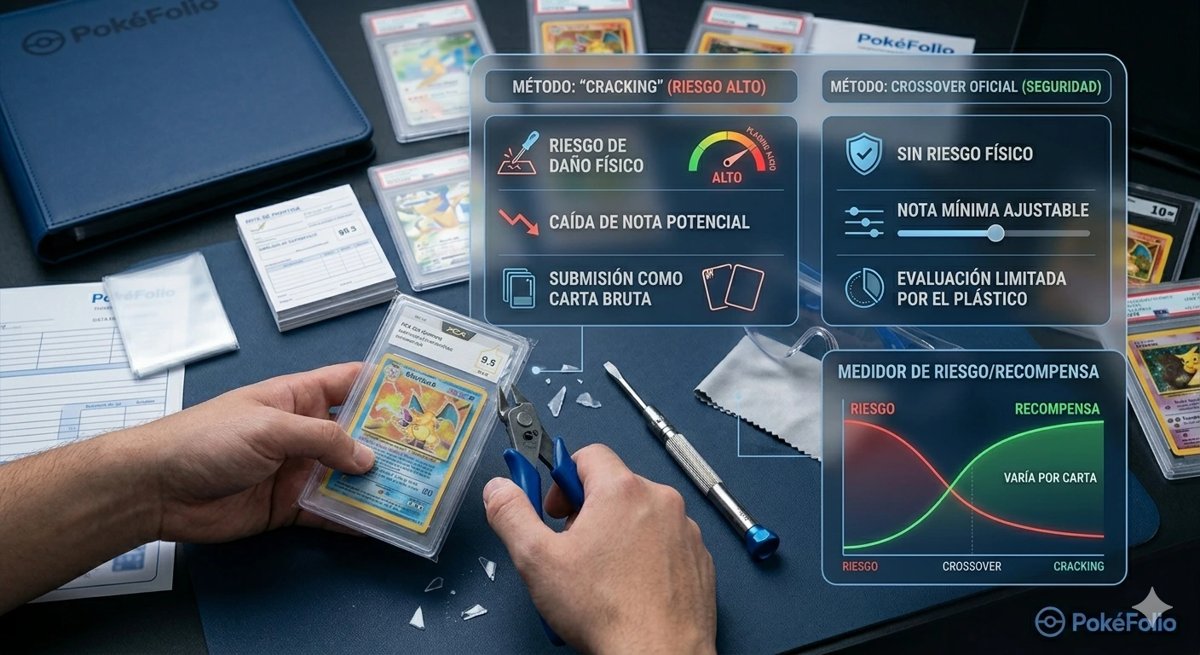
- The Process: A PSA grader will examine the card through the existing plastic. If they determine the card meets or exceeds your "Minimum Grade," they will professionally crack the old slab and re-encapsulate the card in a brand-new PSA holder.
- The Safety Net: If the grader decides the card would only earn a PSA 9, and your minimum was a 10, they will not touch the slab. They simply return the card to you in its original PCA or BGS housing.
- The Pros: This method carries zero physical risk to you. You don’t have to worry about shards of plastic or slipping tools damaging the card.
- The Cons: Graders are notoriously conservative during crossovers. It is difficult to judge surface scratches or centering perfectly through a layer of potentially scuffed or reflective plastic. Consequently, many cards that would grade higher if sent raw are rejected during the crossover process because the grader "played it safe."
2. The "Cracking" Method (The Risky DIY Route)
For many veteran collectors and "flippers," the official crossover service is too restrictive. Instead, they opt for "cracking", the manual, physical removal of a card from its slab so it can be submitted to a new company as a "raw" card.
Should I crack my graded Pokémon card? To answer that, you have to understand the motivation behind it. Often, this is a play for "arbitrage." A collector might find a card in a PCA 9 or a BGS 8.5 that they believe was graded too harshly. By cracking it and sending it to PSA, they are betting that a fresh pair of eyes will see a PSA 10. Given the price gap between a "9" and a "10," this move can sometimes triple the card's market value overnight. This is often the logic behind a PCA to PSA crossover attempt.
3. How People Actually Crack Slabs (Educational Only)
The process needs to be handled with extreme caution because you have determined that the reward value exceeds the hazard value. How to crack open a Pokémon slab safely? The "secret" technique: every collector has their own, but the following method serves as the most common educational framework that collectors use in their hobby work.
Disclaimer: The following information is for educational purposes only. Cracking a slab involves significant risk of personal injury and damage to the card. Proceed at your own risk. If you are asking "how to crack a PSA slab," the process is similar, though PSA plastic tends to be "brittler" than the more robust, thicker PCA slabs.
- Safety First: Safety goggles are mandatory. When a sonic-welded slab breaks, it doesn't just "pop"; it shatters. Tiny, needle-sharp shards of plastic can fly several feet, and eye injuries are a real possibility.
- Identify the Weak Point: Most collectors focus on the top corners of the slab, away from the card and the label.
- The Nipping Technique: Using heavy-duty tile nippers or specialized pliers, professionals will "nip" the very top corner of the slab. The goal is to create a small fracture in the sonic weld without letting the tool enter the internal chamber where the card sits.
- The Lever Principle: Once a corner is cracked, a thin, flathead screwdriver is gently inserted into the gap. How to safely open a graded card case relies on patience. You slowly work the screwdriver along the edge, prying the two halves of the "sandwich" apart.
- The Final Extraction: Never pry near the actual card. Once the pressure is released and the two halves of the plastic are separated, the card (still in its internal sleeve) should be carefully lifted out with microfiber-covered fingers or tweezers.
4. The Verdict: Cross Grading Pokémon Cards - When to do it?
Is it better to crack a slab or send it for crossover? Deciding whether it is better to crack a slab or send it for crossover depends on your experience level and the value of the card.
The Official Crossover is for:
High-value vintage cards (1st Edition Base Set, etc.) where a single scratch caused by a DIY crack would result in a five-figure loss. It is also the best choice for those who aren't comfortable with physical tools.
The Cracking Method is for:
Mid-tier "modern" cards or collectors looking to consolidate their collection into a single brand (like PSA) for aesthetic reasons. If you are confident in your hand-eye coordination and prepared for the possibility of a "worst-case scenario," cracking often yields better grades because the grader sees the card in its raw, unobstructed glory.
Can a BGS 9.5 become a PSA 10?
Absolutely! It happens every day. However, the path you take to get there (whether the safe Crossover route or the daring DIY Crack) should be chosen based on your tolerance for risk.
Can you send a PCA graded card to PSA?
Yes, and with the new European facilities opening, the PCA to PSA crossover trend is expected to grow as collectors seek to align their European finds with the global PSA standard.